BFAR 8 urges Eastern
Visayas to turn ‘White Gold’ into local prosperity
By
SAMAR NEWS.COM
May 29, 2026
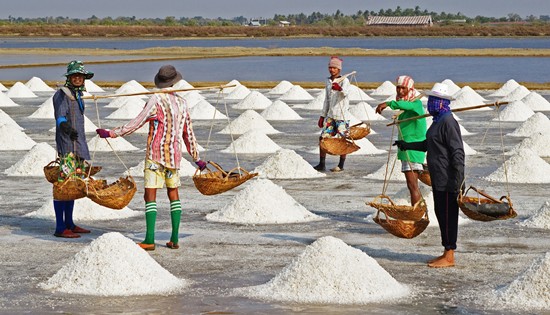
CATBALOGAN CITY –
The Bureau of Fisheries and Aquatic Resources (BFAR) Region 8 is
calling on coastal communities across Eastern Visayas to stop being
passive consumers of imported salt and instead become active
producers, leveraging the region’s abundant seawater, land, and
labor force.
The appeal was made during
the Regional Orientation and Stakeholders Consultation on the
Development of Salt Industry Project (DSIP) held on May 25–26, 2026
in Tacloban City. The two-day event gathered private salt producers,
traders, and fisherfolk associations from the six provinces of Leyte,
Southern Leyte, Biliran, Samar, Eastern Samar, and Northern Samar.
“We are here today because
we possess the land, the sand, the sea, and the labor. It is time to
transition from passive consumers to salt-reliant producers,” said
Loreginia P. Briones, DSIP Regional Focal Person for BFAR Region 8.
National Salt Program
Management Office (NSPMO) Head Dr. Hannibal Chavez framed the
initiative in more evocative terms.
“Ang asin o ‘white gold’
ay hindi lamang simpleng produkto – ito ay simbolo ng oportunidad,
kabuhayan, at pag-asa,” Chavez said.
Participants expressed
strong optimism, particularly small-scale fisherfolk who see the
project as a lifeline for coastal livelihoods. Ruel Inoc, a
fisherfolk representative from Dawahon Island in Bato, Leyte, said
he was pleased to learn that even island communities with limited
space could establish salt production facilities.
“Ako naman natutuwa dahil
di pala imposibleng magkaroon din kami ng pagawaan maski sa maliit
na lugar lang gaya ng isla. Malaking kapakinabangan ito lalo pa sa
mga organisasyon, asosasyon at kooperatiba,” Inoc said.
The consultation focused
on the implementation of Republic Act No. 11985, the Philippine Salt
Industry Development Act, which seeks to revitalize and modernize
the local salt sector. Resource speakers presented the Philippine
Salt Industry Development Roadmap 2025–2040, an overview of the DSIP,
the Salt Information Management System (SIMS), and sustainable
production technologies including solar crystallization modules,
improved post-harvest handling, quality enhancement measures, and
salt convergence mapping.
The activity also served
as a venue for participants to voice concerns, share best practices,
and explore ways to make Eastern Visayas salt more competitive in
the market. It was attended by key officials including Regional
Fisherfolk Director Jesus Patilla, Farmer Regional Executive
Director Engr. Miguel Pedroso, DSIP National Planning Focal
Charmaine Buitre, and representatives from BFAR regional and
provincial offices. Partner agencies from the Department of Trade
and Industry (DTI), Department of Science and Technology (DOST), and
DENR-Environmental Management Bureau also showed support.
The push for self-reliance
comes after decades of decline in the Philippine salt industry.
Following the passage of the ASIN Law, which mandated iodization,
the sector received little government support. As a result, the
country now imports roughly 90% of its annual salt requirements,
primarily from Australia and China, with additional supplies from
Thailand and New Zealand
Cheap imported salt
flooded the market, driving down prices and forcing many local
producers to scale down or shut down operations. This led to
widespread loss of livelihood, heavy foreign exchange spending on
imports, and greater vulnerability to global supply disruptions.
Salt-dependent industries such as fish processing and food
manufacturing have also been affected.
Organizers hope the DSIP
will reverse this trend by empowering coastal communities,
introducing modern and climate-resilient production methods, and
rebuilding a robust local salt industry that can once again serve as
a pillar of economic and food security in Eastern Visayas.