Fisherfolk in Daram,
Samar turn seawater into profit with new salt-making livelihood
By
SAMAR NEWS.COM
September 18, 2026
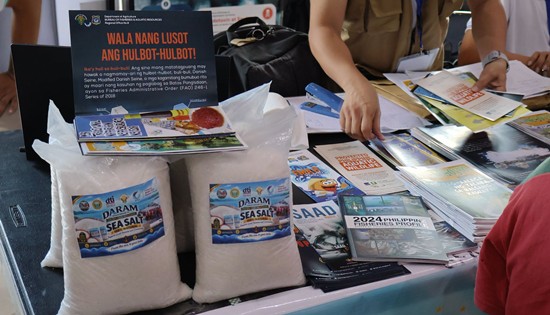
CATBALOGAN CITY –
Coastal communities in the island municipality of Daram are tapping
into their most abundant resource to create a promising new source
of income: seawater. Through the Development of the Salt Industry
Project (DSIP), local fisherfolk associations have successfully
launched solar salt production initiatives, providing a vital
economic boost and a steady supply of salt for their existing
fish-processing activities.
The initiative emerged
after a joint study by OCEANA Philippines and the Center for
Sustainable Aquaculture and Agri-based Innovation (CENSAAI) revealed
nearly 40 percent in post-harvest fish losses in the area.
Recognizing the need to support fish preservation, stakeholders
identified local salt production as a strategic, low-cost solution
for Daram-an island composed of 57 coastal communities where 98
percent of residents work as municipal fishers.
“Why do we need to buy
salt from other regions or rely on imports when Samar is naturally
surrounded by seawater?” asked Oscar M. Lim Jr., the designated
officer of the Office of the Municipal Agriculturist-Fisheries
Services (OMA-FS). “Through local production, there is also an
opportunity to reduce reliance on supplies that must be purchased
from outside the municipality while providing productive livelihood
opportunities for our coastal communities.”
Empowering Women in
Coastal Communities
The program has proven
particularly beneficial for women. Gilda Dosal Añez, President of
the Daram Association of Fish and Squid Processors, highlighted the
accessibility of the trade.
"Salt-making has great
potential as a livelihood because it does not require a large amount
of capital and can be easily managed, particularly by women," Añez
shared as her association reaped the initial fruits of the project.
Using a simple but careful
process, the women filter clean seawater and place it in drying
areas lined with Low Linear Density Polyethylene (LLDPE). The setups
are covered with UV film to protect the salt from dust and
contaminants. After four to five days of sunlight-driven
evaporation, salt crystals form and are ready to be harvested.
The first production cycle
has already yielded 180 kilograms of salt, which the associations
are utilizing directly in their fish-drying activities. Excess salt
can be sold locally for P20 per kilogram, creating a direct
supplementary income stream.
Multi-Sectoral Support and
Investment
The success of the
salt-making venture is the result of collaborative support from
government agencies, civil society, and the academe. The Local
Government Unit of Daram organized the associations, provided
initial seed capital, and connected them with relevant agencies.
CENSAII of Northern Samar offered hands-on technical assistance and
benchmarking opportunities.
Crucial funding and
materials came from the Bureau of Fisheries and Aquatic Resources (BFAR)
Region 8 through the DSIP. The Daram Association of Fish and Squid
Processors (16 members) and the Brgy. Ubo Dried Fish Vendors
Association (25 members) received a combined P750,000 worth of
equipment, including a generator, a submersible pump, and HDPE
drums. Additionally, both groups received P100,000 each in LLDPE
liners, alongside comprehensive capability-building training held in
Tacloban City.
Looking Ahead: Expansion
and Regional Reach
Building on their early
success, the associations plan to expand by adding more liner setups
and moving toward the mass production of iodized, food-grade salt.
They are also exploring value-adding opportunities and hoping to
replicate the technology in neighboring barangays.
To support this growth,
BFAR 8 is set to distribute P300,000 worth of Collapsible Salt
Production Setups to Daram associations, aiming to further increase
production capacity.
The Daram project is part
of a broader regional push by the DSIP in Eastern Visayas, which has
identified 230 individuals from 13 associations and one cooperative
to receive similar salt production interventions. Targeted areas
include San Roque in Northern Samar; Maasin and Hinunangan in
Southern Leyte; Baybay City in Leyte; Guiuan and Arteche in Eastern
Samar; and Naval and Maripipi in Biliran.