What path should
humanity take?
10th Anniversary of the Declaration of Peace and Cessation of War (DPCW):
From war to peace
By
HWPL
March 19, 2026
|
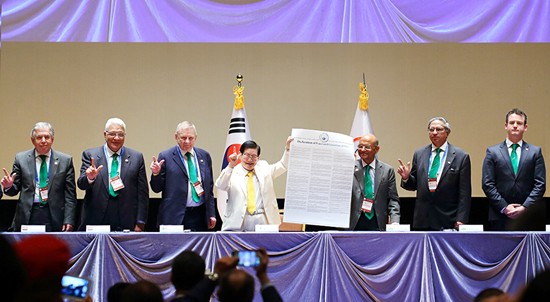
Proclamation
of the 10 articles and 38 clauses of the DPCW on March 14,
2016. |
War remains a reality of
international politics. Conflicts and armed clashes continue to
erupt, and despite the existence of international law, war has not
disappeared. How long must humanity continue to endure this cycle?
If conflict is inevitable, must war also be the way we resolve it?
The Declaration of Peace
and Cessation of War (DPCW), proclaimed on 14 March 2016, was
presented as a proposal in response to these questions.
HWPL and the DPCW
The DPCW is not a document
born from abstract ideals. Heavenly Culture, World Peace,
Restoration of Light (HWPL), the organization that proclaimed it, is
an international peace NGO established to protect lives lost in war
and to build a sustainable peace order.
The background of its
founding lies in the wartime experience of HWPL Chairman Man-hee
Lee. As a student soldier during the Korean War, he experienced
firsthand the devastation of war. The conviction that the cycle
repeatedly sending young people to war must end with this generation
later inspired international peace initiatives. The September 18th
HWPL World Peace Summit, held in Seoul on 18 September 2014, became
an important turning point. At the event, attended by a total of
1,933 participants from 152 countries, participants shared a
consensus that international standards are needed not only to
respond to conflicts after they occur, but also to prevent them and
institutionalize cooperation.
To translate this vision
into concrete form, HWPL launched the HWPL International Law Peace
Committee (ILPC) in 2015, composed of international law experts from
around the world. Through legal review and consultation, the
committee completed drafting the DPCW, consisting of 10 articles and
38 clauses, which was officially proclaimed on 14 March 2016.
The Standards Proposed by
the DPCW
The DPCW sets out
standards on the use of force and procedures for the peaceful
resolution of disputes. It also reinforces the principles of
international cooperation and collective security, while
incorporating the roles of religion and civil society within the
institutional framework.
This document does not
deny the existing international legal order. Rather, it focuses on
clarifying already agreed-upon principles and structuring them so
that they can operate effectively in practice. It is meaningful in
that it represents an attempt to move beyond an order that
presupposes war as a means of resolving conflict. The question
raised by the DPCW is simple: even if conflicts exist, must they
necessarily result in war?
Expansion of International
Support
Since its proclamation,
the DPCW has gained support from international organizations and
national parliaments. Regional parliamentary bodies—including the
Pan-African Parliament (PAP), the Central American Parliament (PARLACEN),
and the Latin American and Caribbean Parliament (Parlatino)—have
adopted resolutions endorsing the initiative, while about 900,000
endorsements have been collected from citizens in 178 countries.
This demonstrates that
norm diffusion is taking place not only through state diplomacy but
also through civil society. Yet reality remains complex.
International conflicts persist, and power politics remains
entrenched. The transformation envisioned by the DPCW is still
unfolding.
Beyond the Era of War:
Leaving Peace as a Legacy for Future Generations
For a long time, humanity
has ended conflicts through war whenever they occurred. The pattern
of determining order through superiority of power has been repeated.
The issue raised by the
DPCW is structural. Even if conflicts do not disappear, the way they
are addressed can change. The question is whether it is possible to
build an order that manages conflicts within standards and
procedures, cooperation and institutions, rather than through armed
clashes.
The past decade has been a
period of raising this question to the international community and
accumulating institutional and social foundations. The task ahead is
to ensure that these standards operate within the actual
international order.
What Path Should Humanity
Take?
Not toward a path where
war remains a means of addressing conflict, but one that seeks to
structure and institutionalize peace.
Conflicts may be
unavoidable. However, whether they are allowed to escalate into war
or addressed through a different standard ultimately depends on
humanity’s choice. The DPCW represents an effort to give this
transition a concrete institutional framework. The discussions and
global expansion over the past decade have demonstrated that such a
vision is possible.
One question remains: Will
these standards take root in the international order, or remain yet
another declaration?